80-Bus News |
January–February 1984 · Volume 3 · Issue 1 |
| Page 35 of 55 |
|---|
Aunt Agatha’s Agony Column
By David Parkinson
GM809,
GM829
compatibility/upgrading
This is a question that has cropped up several times recently. The answer
is that the Gemini GM829 FDC/
The software controllable 5.25″/8″ switching of GM829 is quite useful –
even if you don’t have 8″ drives connected to your system. This is because the
Western Digital Floppy disk controller used on
GM809/
BASIC mathematics
A letter from Phil Dunglinson on the topic of a BASIC program that doesn’t work provides me with my next topic. The listing is shown below:
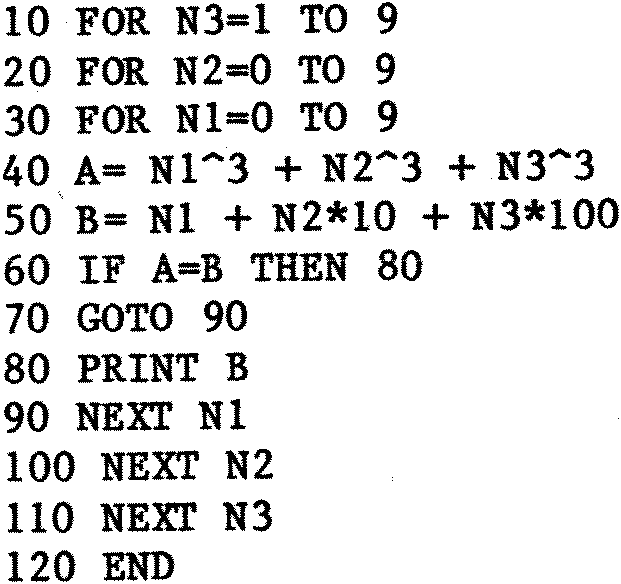
It should print out the results of 153,370,371,407 but doesn’t. Can anyone see why not?
The answer is simple, and reminds me of that old adage about not blindly accepting the answer that comes out of a computer. Just because your computer tells you that 2<>2 or 3=2 does not necessarily mean that it is true. Remember that your computer is an idiot and tries to do exactly what you tell it. It can do mundane operations very quickly, but it does have limitations and this example highlights twoof them.
Point 1: Derived Arithmetic Functions.
To us normal Human Beings N1^3 (N1 raised to the power 3) in line 40 of the above program means N1*N1*N1. However to Nascom BASIC it means: EXP(3*LOG(N1)), where both the LOG() and the EXP() are calculated by evaluating polynomial approximations of the form:
C0 + C1*X + C2*X^2 + C3*X^3 + … + CN*X^N
X is the value passed to the approximation routine, and C0,
| Page 35 of 55 |
|---|