80-Bus News |
September–October 1983 · Volume 2 · Issue 5 |
| Page 62 of 67 |
|---|
The program goes like this:
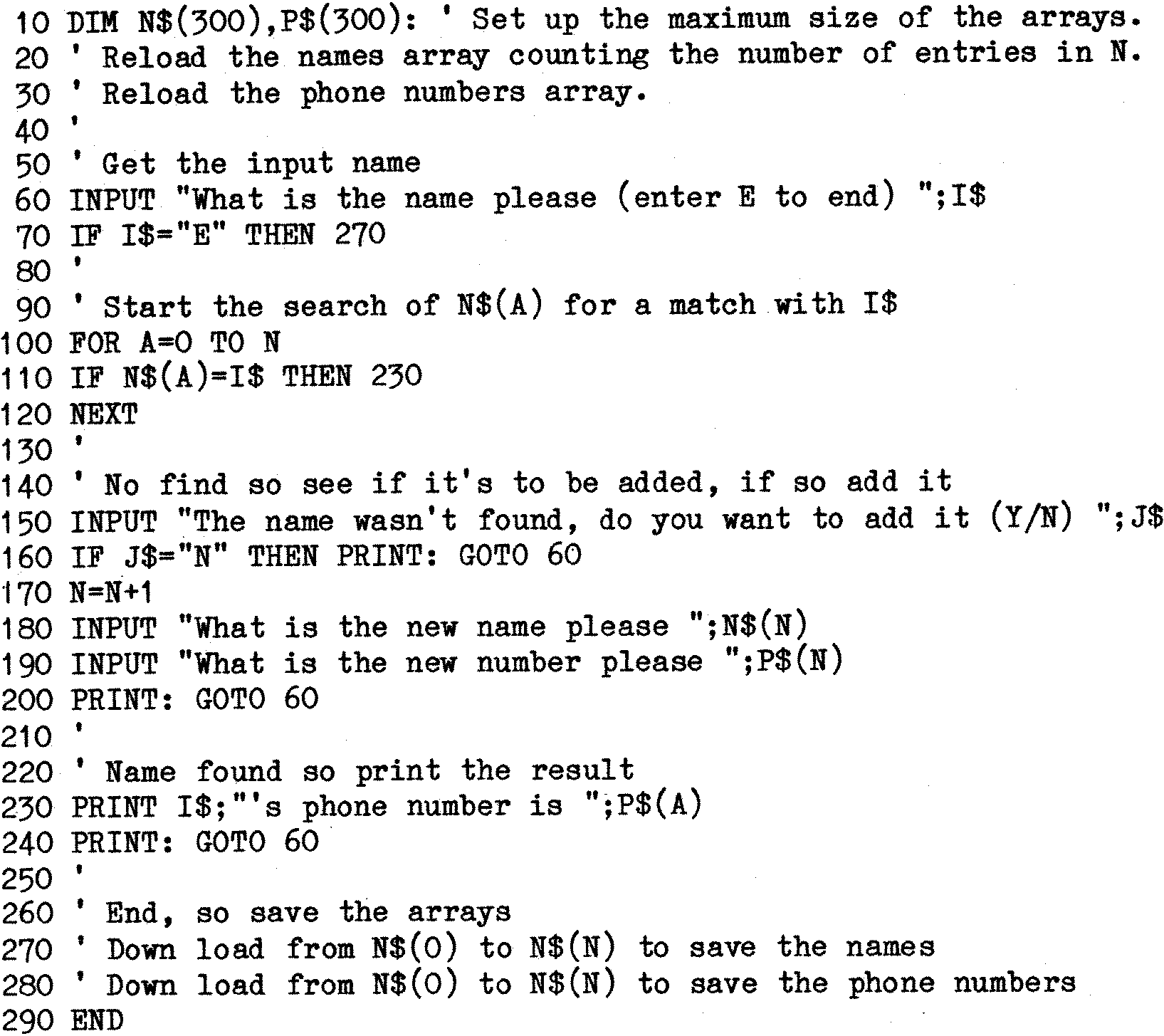
All very easy stuff, using two parallel one dimensional arrays, one, N$(n) as the key, the second P$(n) as the data. Notice that I chose to use a string array for P$(n) even though it only contains numbers. This is because it needn’t only contain numbers, for instance I always write phone numbers, 01-402-6822, which certainly isn’t numeric (that isn’t my number by the way, so don’t try it.) Or P$(n) could contain an address as well as the phone number, or recipes (short ones as string length is restricted to 255 characters), or, well, you name it.
THE HARDER BIT
Having looked at both types of commonly used database, the random
access and the sequential (and the sequential free field type) and having
looked at the way in which the data would be split up into fields within the
records in the file (neat summary that, databases consist of fields in a
record in a file). It is plainly obvious that both types of database have
snags when it comes to access. The sequential database can usually only be
looked at in a sequential manner, which means that if the file is of any
length, then access time to any record will depend on the position of that
record within the file. If it happens to be at the end of the file it just
takes a long time to get at, tuff!! The problem with the random access file is
not so much the access time, it only takes a few milliseconds to move the disk
head to the correct track/
| Page 62 of 67 |
|---|