80-Bus News |
November–December 1982 · Volume 1 · Issue 4 |
| Page 22 of 51 |
|---|
change. Since this bug may also be present in other versions (with different addresses) the code which should be changed is just after the prompt for the tape number and the three SCALs to process the answer and get it into HL. The code should read:
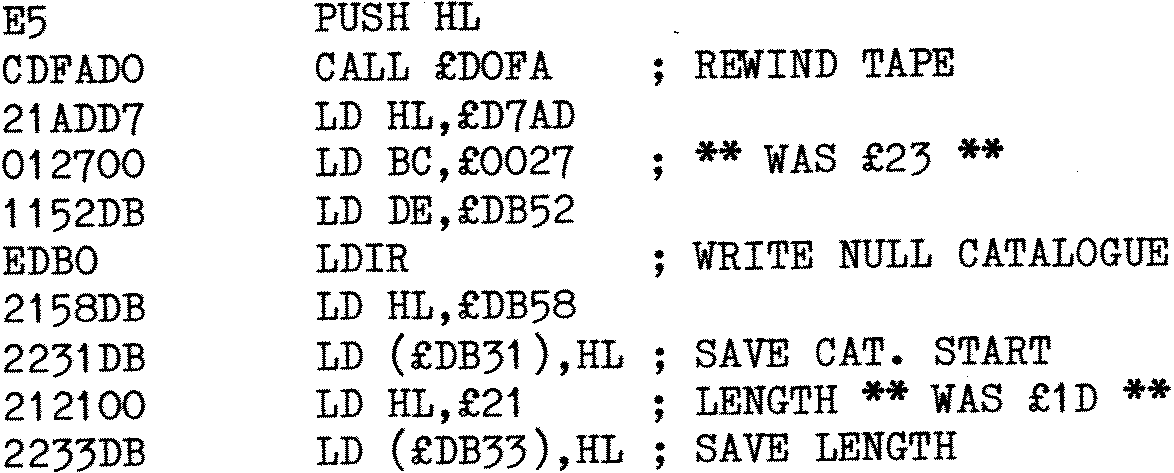
Another undesirable feature (alright then, a bug) in TOS occurs if any
errors occur when using TOS under program control. Since errors can occur at
several ‘depths’ in TOS (e.g. an error in the number of arguments, no tape
present, a read/
The Write command (and B & P) automatically verifies each block after it has been written by rewinding to the start of the block and then ‘reading’ the block (but not loading it into RAM) and checking the CRC character at the end. If an error occurs, the block is rewritten, and if the error persists, the command is aborted & an error message is displayed. A drawback is that the catalogue will still contain an ‘entry’ for the erroneous file, which will have to be deleted.
The I command is used to initialise a tape, and all it does is write a blank directory to the start of the tape. TOS automatically checks to see whether the tape has already been initialised, and displays an error message if it has. No command has been provided to delete the catalogue (e.g. so that it may be reinitialised with another tape number). This is deliberate, as it avoids the accidental ‘erasure’ of a whole side. It can be done, however, by outputting the relevant commands to the ports, and this method is given in the manual. TOS also remembers where it is on a tape, so when reading more that one file off a tape, there is no need to read in the catalogue both times (or even the once). TOS cannot, however detect if a tape has been removed & replaced with another one. Thus the ‘R’ command (no arguments) is best used immediately after inserting a cassette.
TOS is written for Nascom systems using NASSYS monitors (sorry, all those Nasbug fans) and automatically detects whether NASSYS 1 or 3 is in use. Much use is made of NASSYS routines but not every call is made in the Approved Manner. The offenders are the call to Parse and to Errm. I don’t see why Errm is called (when an invalid command is entered) instead of the address of TOS’s own error routine (which calls ERRM anyway in the Approved Manner). These routines are called by reflections in RAM, so should your NASSYS be different (e.g. NASSYS 4 if & when,
| Page 22 of 51 |
|---|